
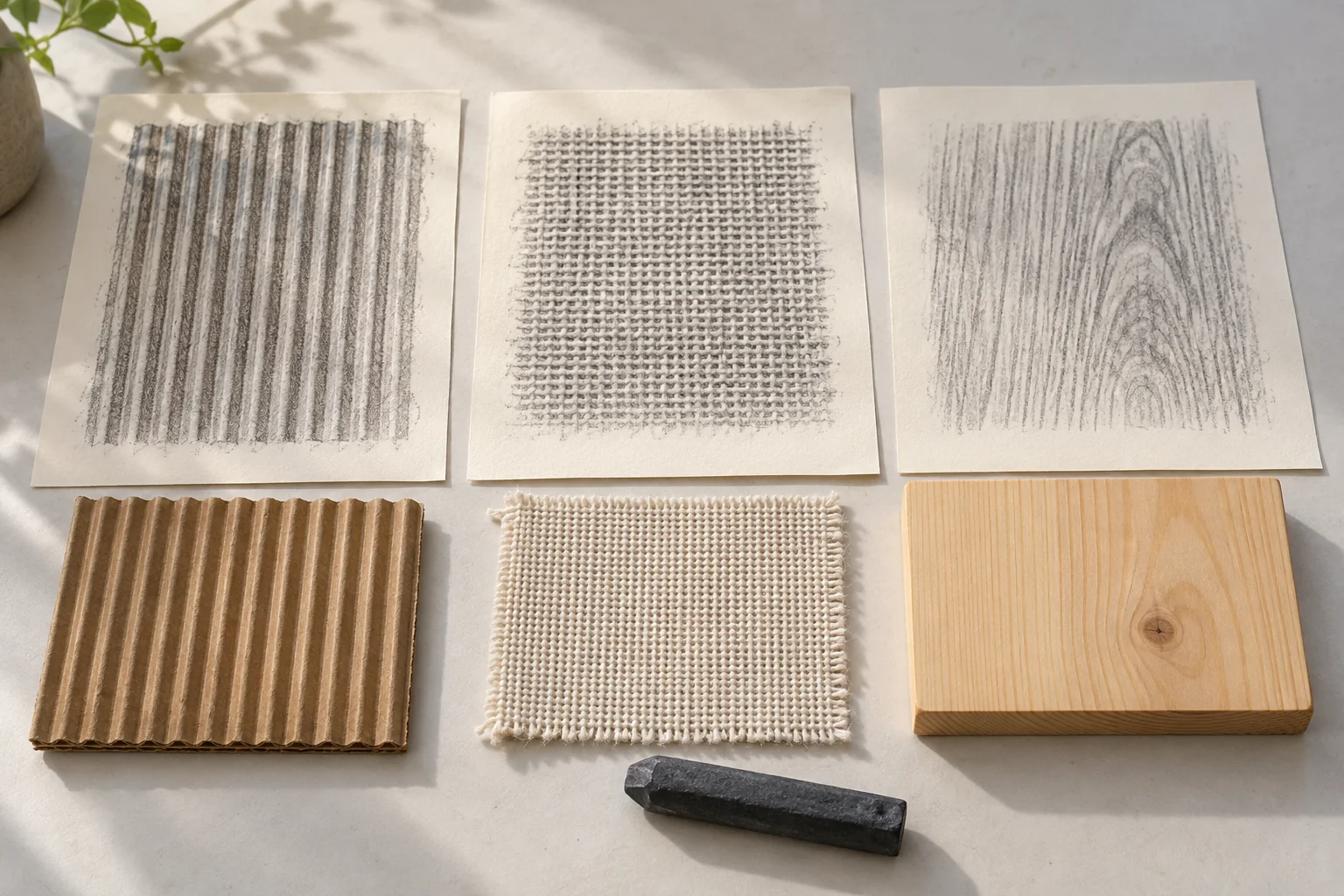
Frottage reveals a surface through rubbing a drawing tool over paper placed on top of it. The exercise offers a simple way to notice textures usually seen only briefly. Cardboard, fabric, and wood can produce different directions and line densities even when the tool and paper size remain the same.
Choose three household materials you are allowed to use that are clean, dry, and easy to lay flat. Prepare paper and a graphite pencil that is not too sharp. The initial aim is to compare marks rather than immediately create a finished drawing. A few small samples are enough to begin noticing differences.
Choose clearly defined surfaces
For a trial, use cardboard with perceptible ridges, textured cotton fabric, and smooth wood without splinters. Select loose objects permitted for practice. Avoid rubbing over someone else’s belongings, valuable objects, or easily damaged finishes.
Check materials before placing the paper. Sharp, dirty, wet, or unstable surfaces are unsuitable for this exercise. If children participate, an adult selects appropriate materials and tools. Interesting texture does not require hazardous hard objects.
Use roughly equal areas for the three materials. Label the sheet edges so results do not become confused after moving them. A material name provides a comparison reference; it does not imply that every fabric or wood type produces the same image.
Prepare the surface and keep the paper flat
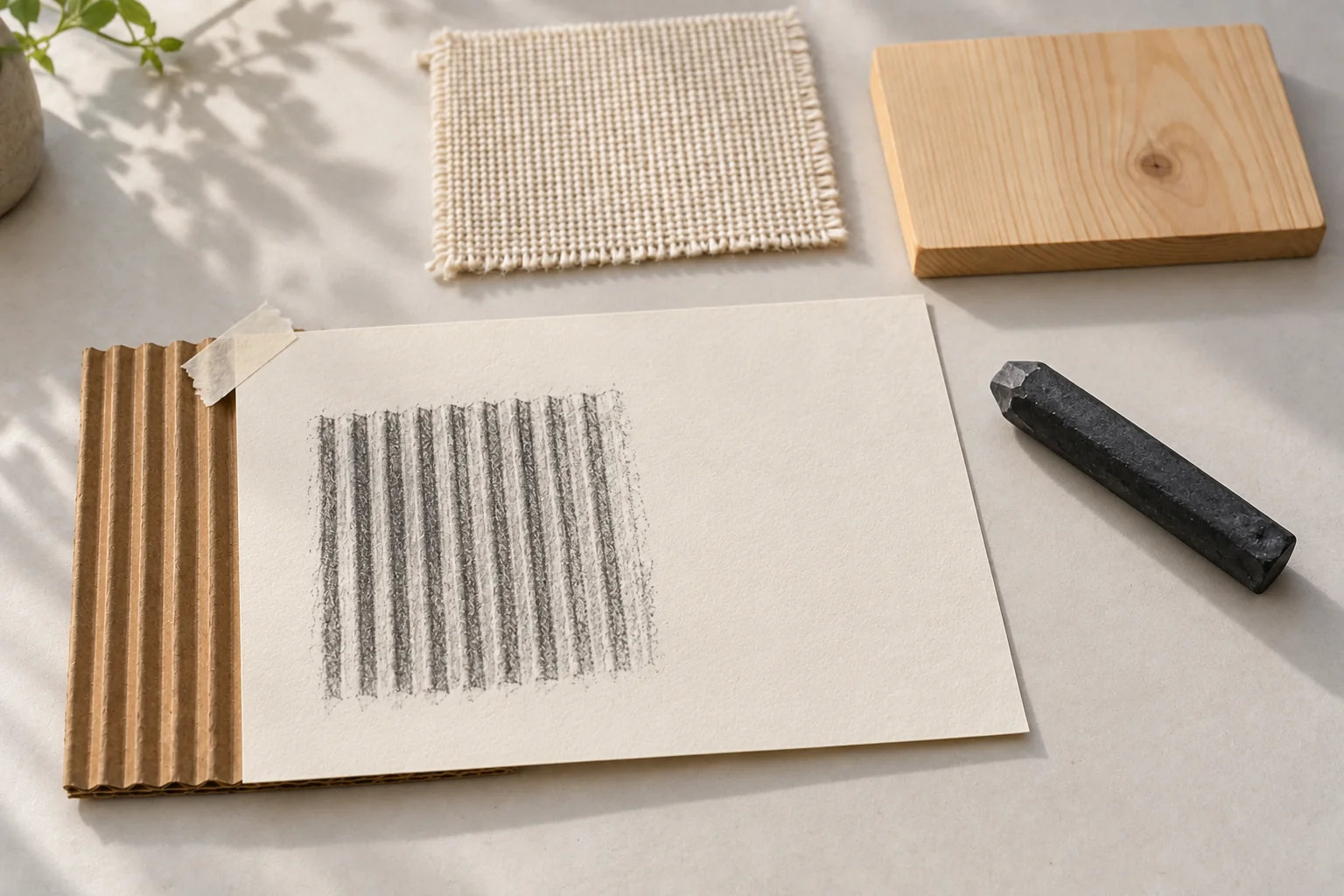
Place the material on a stable table and lay the paper over it. Choose an area without large folds so the marks mainly come from the material beneath. Hold the paper in place using a method that does not damage the object or obstruct the rubbing area.
Begin with cardboard because its ridge direction is usually easy to observe. Feel the direction lightly if the material is safe to touch, then check the paper position. Avoid shifting the sheet midway. Movement can create doubled marks that complicate reading the original texture.
Hold the pencil at an angle allowing the graphite side to touch the paper. Try a light rubbing over a small area first. If the paper tears or marks become too dense, stop and adjust pressure or materials. Strong pressure is unnecessary to demonstrate texture.
Use the same tool for the first trials
Use one tool on all three initial surfaces. Keep pressure and area as consistent as practical so material differences are easier to see. Build the rubbing gradually and stop before the entire area becomes uniformly dark.
With fabric, observe whether the weave produces dots, short lines, or repeated directions. With wood, look for long grain lines or subtler variations. Marks depend on the chosen material, so your result may differ from an example.
Do not correct the rubbing to match an imagined texture. An area that produces few marks is also an observation. Note if the surface seems too smooth, the paper too thick, or the material difficult to hold still.
Compare the rubbings from three surfaces
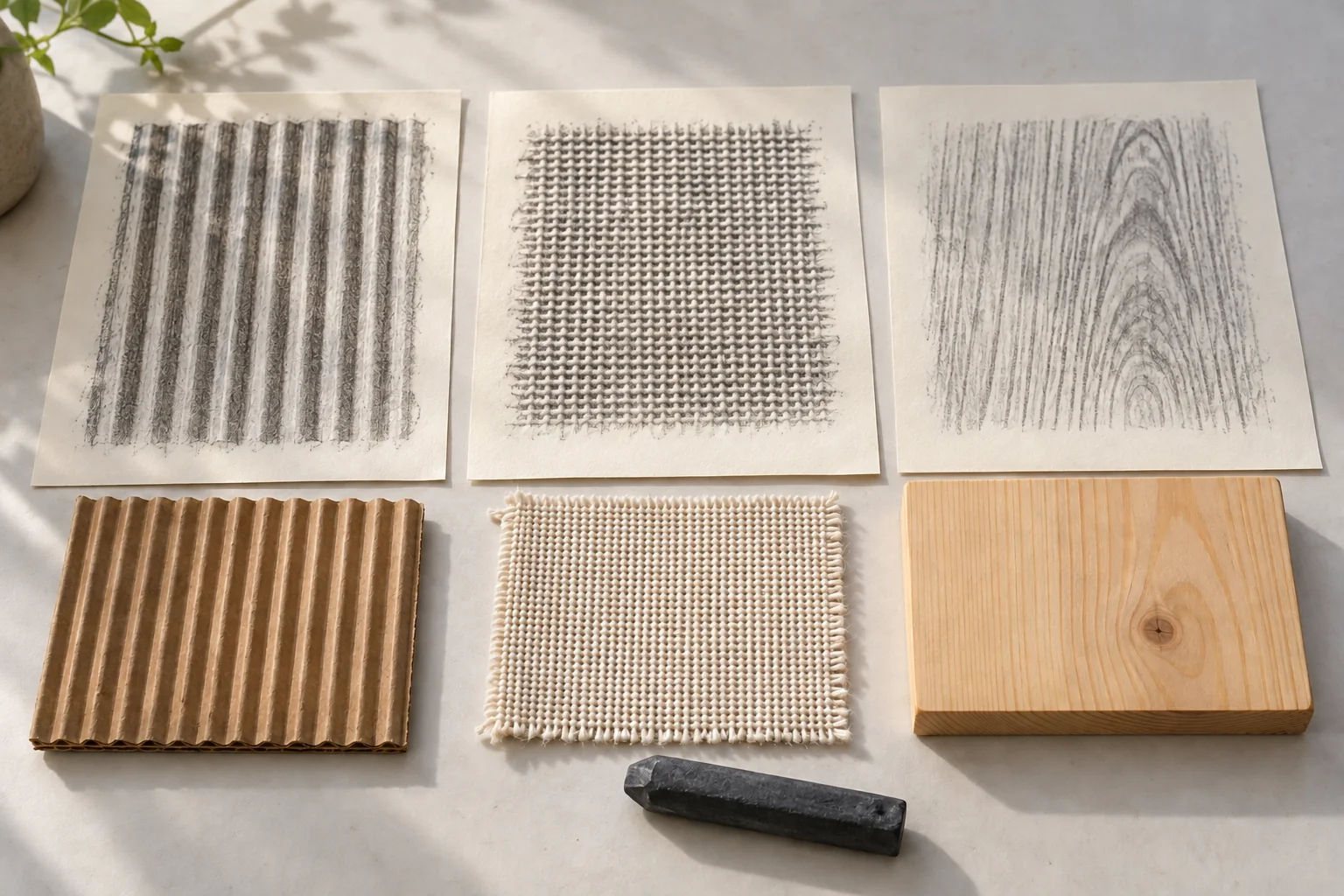
Place the three results side by side and use the same questions. Which has the clearest direction? Which looks dense? Does one appear soft because of small line differences rather than simply a lighter colour?
Consider the relationship between the surface and image. Cardboard ridges may produce parallel repetition, fabric may show a weave, and wood may give less regular lines. Describe what your own samples show without assuming the same property applies to every material in that group.
| Observation | Comparison question |
|---|---|
| Direction | Do lines follow one direction or several? |
| Density | Are marks close together or separated by open space? |
| Repetition | Is there a clearly repeated interval? |
| Small variation | What changes within one area? |
Select one particularly interesting difference. The exercise is more useful when you can explain your choice rather than simply call one result the best.
Change one factor for the second trial
Use one material again and change the rubbing direction while keeping the tool and paper the same. Compare whether the texture looks different. Another trial could use lighter pressure, but avoid changing every factor at once.
Write a short note about the change. A crosswise rubbing direction may make one feature clearer, for example. Keep the observation even if the result changes little. A trial does not need a dramatic difference to be understandable.
Retain sheets with their material names and sufficient notes. You do not need to collect every mark. Select examples showing a difference or a question you want to try again.
Use the marks as drawing material
A selected rubbing can become a background, an object’s surface, or the basis for a shape experiment. Decide how the texture relates to the new drawing before adding lines. Leave enough space so texture does not cover every element.
At Zumen, this exploration can continue through other art exercises. Frottage helps you see surfaces through marks you make yourself. With clearly chosen materials and limited changes, texture becomes something you can observe, compare, and deliberately use in visual decisions.