
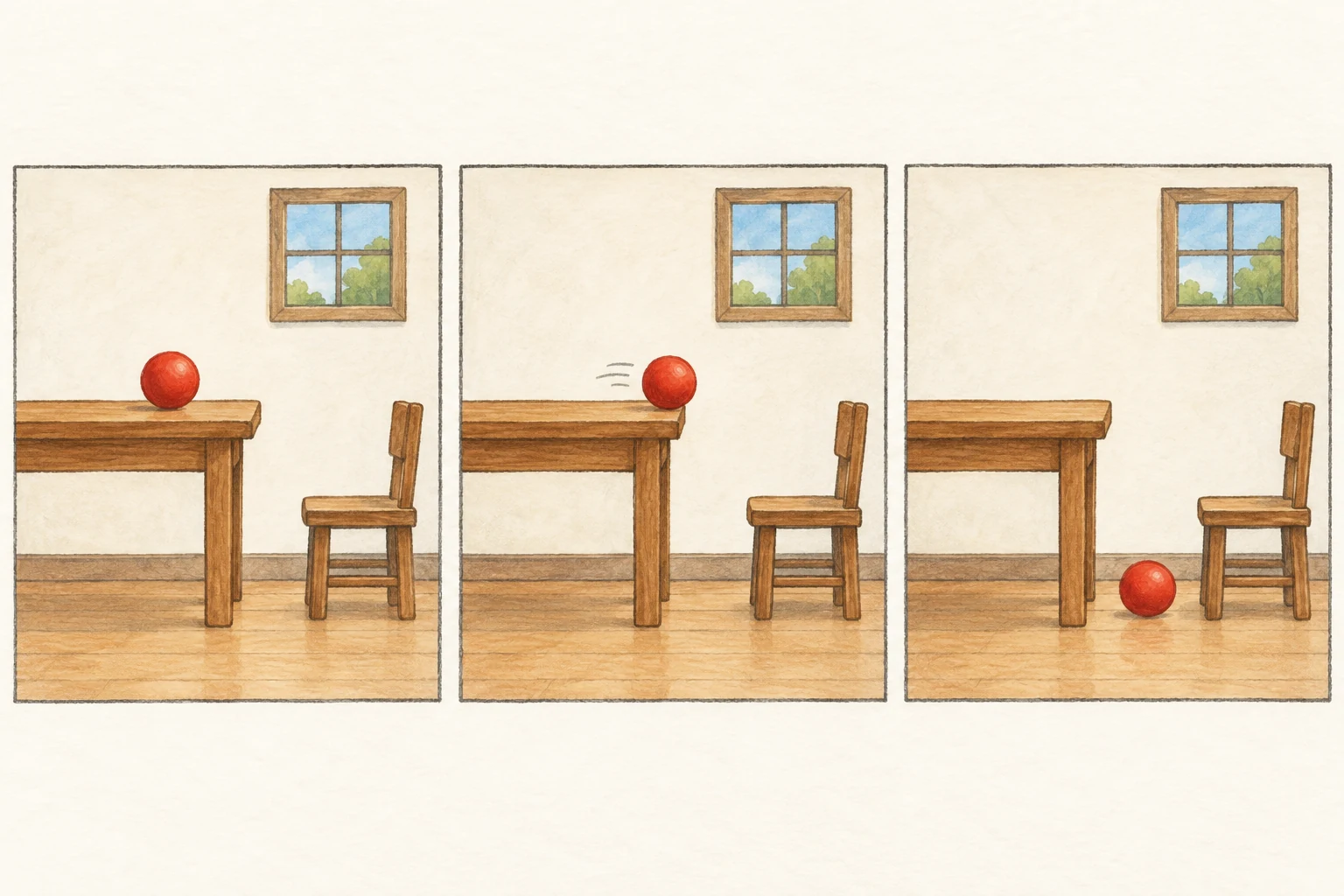
A story can be read through changes in pictures. An object starts somewhere, moves or changes, and reaches a new state. A three-panel exercise helps students choose enough moments to show a sequence without adding explanatory sentences beneath every image.
Start with a simple object and setting. In the example, a red ball moves from the table’s centre to its edge and then rests on the floor. The table, chair, and window remain landmarks. Readers follow one object through three states rather than three unrelated scenes.
Choose one change to tell
Ask, “What is different at the end?” The answer can concern an object’s position, condition, or relationship to another object. For an introductory exercise, choose a clearly visible change without many characters or extra settings.
Another example is a leaf on a path, carried near a fence, and finally caught there. It differs from the ball example but follows the same idea: initial state, change, and result. Students can choose objects they know.
Decide which parts to show and which remain implied. Three panels are a constraint for this exercise rather than a rule for every story. If an idea involves many events, select a small section before expanding it in another exercise.
Plan each panel in a few words
Before drawing, name three states. Here: ball on table, ball reaching edge, ball on floor. Those words support planning but need not appear in the finished artwork. They identify the change the pictures must show.
Check whether the second panel contributes information different from the first. If positions barely change and there is no sign of movement, readers may not recognise an event. Choose a moment bridging the beginning and result more clearly.
The final panel should show a new state rather than repeat the moment of change. A ball on the floor provides a result comparable with its original tabletop position. Students can discuss whether that ending is sufficient or whether to develop a continuation.
Keep the setting fixed and move the object
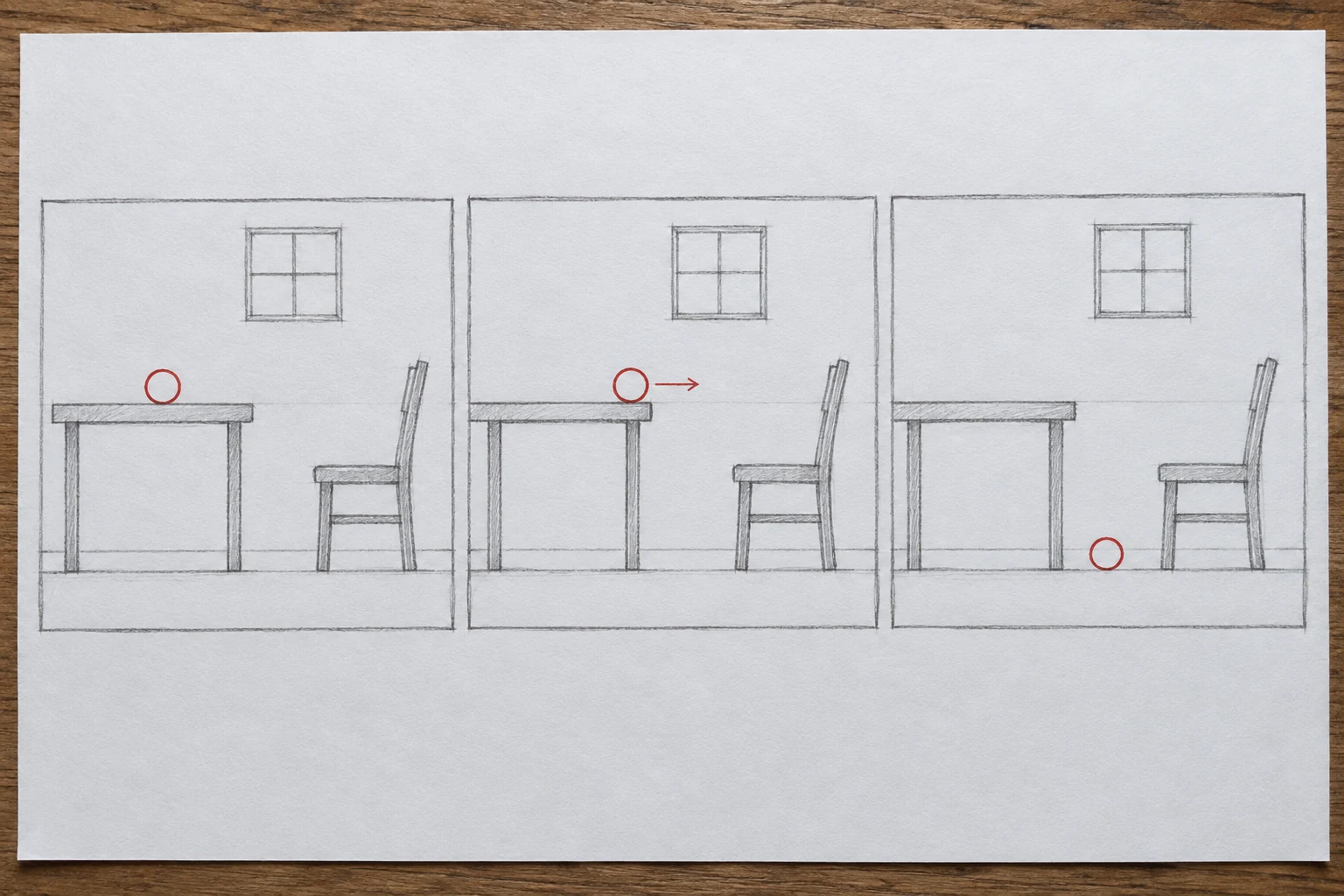
Draw three similarly sized frames. Keep landmarks consistent: table height, the chair on the right, and the window behind. Light construction lines can preserve surface and floor heights during planning.
Once the setting reads clearly, move the main object according to the sequence. Retain recognisable features such as its round shape and red colour. If shape and colour change without a story reason, readers may treat the next object as a different one.
Consider viewpoint. Use the same direction in the first round so movement is easy to compare. Try different angles later if they support the story, once students understand how landmarks preserve relationships between panels.
Use movement cues selectively
Short motion lines in the change panel can suggest direction. Choose cues matching the intended event. Avoid filling the drawing with lines until the object and its main position are hard to see.
Compare the panel with and without a cue. Does position already communicate the change? If so, extra lines may be unnecessary. Students practise choosing useful information rather than filling every empty space with another mark.
Avoid asking readers to infer too many changes simultaneously. Moving a ball and recolouring the entire room can suggest two different stories. Keep other elements stable in this exercise so attention stays on the chosen change.
Check readability before adding detail
Show the sketch to someone without explaining it first. Ask them to identify the recurring object, the second panel’s change, and the final state. Listen for what is understandable and what requires explanation.
If a reader cannot understand why or how the change happens, ask what cue they need. Students can clarify position, movement, or one relevant detail. Not every question needs many additional objects as its answer.
Use the cardboard viewfinder as a related exercise for choosing what enters a picture. A frame supports discussion of included and omitted information. For three-panel stories, choose a view preserving movement landmarks.
Finish while preserving continuity
Add colour and details after the sketch sequence can be followed. Recheck object shapes, relative sizes, and landmark positions. Unintended changes can appear during refinement even when the initial plan is clear.
Every background need not be equally detailed. Choose details supporting the setting and event. If one panel becomes much busier, check whether attention shifts away from the main object. Simplicity helps compare the chosen change in this exercise.
Keep the plan sketch alongside the finished work. Together, they show decisions made during the process. When discussing it with a Zumenart mentor, explain what reads clearly and what to try again. Include the exercise in art practice at home with new stories following the student’s interests.